 |
| Take a deep breath, relax, and join us in Guatemala time |
We have been preoccupied with things other than keeping the
blog current. Sorry for the delay. It has been amazing living in Guatemala
time.
Since our last posting we have had numerous adventures
exploring “the Rio”, the surrounding areas of Guatemala, and, most recently, a
bit of Belize. We will take a little different approach to catching up. Rather
than present a chronological travel log, we present a couple of short stories
and images that we hope you will find entertaining.
Life on the hard- Fixing your boat in
exotic places
Among often repeated and quite worn adages is “cruising is fixing your boat in exotic places”.
Frontereas/Rio Dulce is located 20+ miles from the mouth of
the river which makes it one of the best hurricane holes in all of the
Caribbean. Another attraction to Rio Dulce for boaters is the entire community
of marinas, shops, and competent workers to tackle almost any project at very
reasonable rates. We had plans for several boat projects and we were eager to
tackle them here in the Rio.
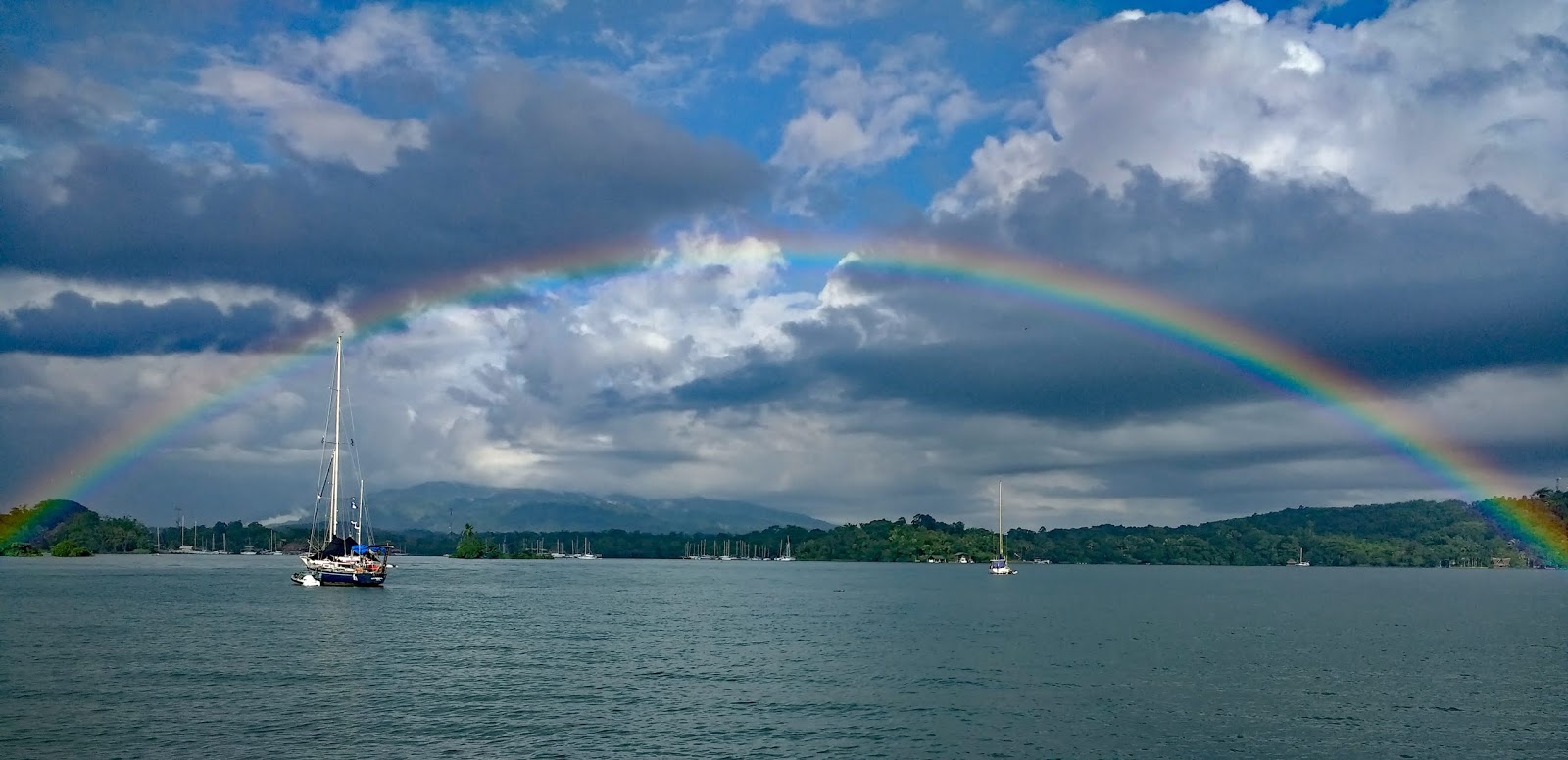 |
| We woke up to full and double rainbows two days in a row while waiting to be hauled out |
 |
| After several days waiting, we were hauled out by tractor and trailer. Yes, one of the marina dock hands has to go into the water to block the boat on the trailer. |
 |
| Once the boat was secure, we got to take a ride through the yard on our boat. FUN! |
Another worn saying is “cruising
is more about intentions rather than schedules”. You put those two things
together and you can guess where we are going with this.
When you haul a boat out of the water and put it on stands
in a boat yard either for storage, or for projects, the boat is said to be “on the hard”. We don’t know the
etymology of this but we can guess that a boat on land is “on the hard” because
land is, well, not soft. But there must be other explanations.
 |
| Our view aboard Leilani on our ride through the yard. |
Life on a boat in a boat yard is hard for a number of
reasons. We know most all of the reasons because we had been living “on the
hard” for almost three months! Endless inconveniences of nearly all of life’s
activities abound “on the hard”.
Here are just a few of the hard things:
-You are living on a heat reflective concrete pad. It is really, really hot for several hours
mid-day.
-You cannot keep the dust from sanding bottom paint and
fiberglass off your boat.
-You have to listen to noisy sanders, drills and other tools
that power up early each morning and go all day.
-You have to climb a ladder on and off the boat while taking
great care not to fall off. (We have assisted several cruisers with
concussions, broken ribs, fingers, and toes).
-You do not have potable water. You lug multiple 6-gallon
jugs of drinking water up the ladder to pour into your water tanks.
-You have to take cold water showers. The water heater in the community shower was
broken for about three months.
-You have to set up a bucket to avoid climbing the ladder and
walking to the toilet at night.
-You have to pee in that bucket on the boat.
-You have to empty that bucket.
-You have to do dishes at a sink in the yard – at the
opposite side of the yard.
-You have to accept the chaos tools, parts and clutter from
all of your projects still in progress.
-You have to carry bags of laundry overland and then via the
dinghy to a laundry service.
 |
| Collection of flip flops at the ladder means work is being done! |
 |
| A glimpse of the chaos and clutter from life "on the hard" |
We were not actually working every day on boat projects over
these last months. While we waited on boat parts ordered the first day
“on the hard”, we tackled some less urgent projects. Cosmetic varnishing and
sewing projects came to the top of our “to do list” as the critical replacement
of the propeller shaft cutlass bearings and seals moved to the bottom of the
list. Some days after some particularly overheated labor we would wander to the
pool and then celebrate any minor or major accomplishment with a beer at the
boat. It was not always a hard day “on the hard”. Some days this is true- “Even a bad day on the hard, can be better
than a good day at work.”
 |
| Tracy working on salon window shades. |
 |
| Bud working on a nap |
 |
| Brightening up Leilani during the holidays |
Although we did have a schedule for our time in Guatemala, even
the most poorly defined schedule was eventually thrown out as we waited for
essential boat parts. We learned that our parts had been delivered in Guatemala
City in October but were to remain in customs for “analysis”. We never learned
what “analysis” meant. Despite the best efforts of our competent and gracious
shipping agent, we all grew weary of the endless delays and excuses that
spanned nearly 2 ½ months. The parts were finally released the Friday before
Christmas! The invoice from the customs office added “insult to injury” by adding
the charge for “storage” of the parts at the warehouse!
 |
| Long wait, small package |
 |
| Leilani looking good and ready to go back in the water |
We were creative in reducing some of our frustration by
escaping on several excursions to explore Guatemala.
Antigua, Kite Festival, Day of the
Dead, All Saints Day, Halloween
We joined a group of cruising characters on a road trip to
share the festivities surrounding Day of the Dead, All Saints Day and Halloween
in and around the gem of a town, Antigua. We were told the festivities were not
to be missed, and we were not disappointed. Admittedly, the combination of
mixed religious festivities encompassing pagan, Catholic, and Maya rituals were
at times entertaining, confusing and surreal.
Antigua
The picturesque town of Antigua is located about a 1 ½ hours
west of Guatemala City, in a valley encircled by volcanoes. The rooftop view of
the volcanos from our hotel was pretty spectacular.
 |
| Rooftop view of Agua Volcano from our hotel in Antigua |
 |
| Fuego Volcano (in the distance) and Acatenango Volcano surrounding Antigua. Fuego is erupting in this view |
Antigua was the third capital of Guatemala and remained so for
about two hundred years. A series of earthquakes eventually destroyed much of the
city after which the capital was moved to its current location in Guatemala
City. Antigua is known for its well-preserved Spanish-Baroque influenced
architecture and has been designated a UNESCO World Heritage site. Walking down
the narrow cobblestone streets lined with colorful buildings and elaborately
decorated churches, it feels like you could be walking the streets of a small
town in Spain.
 |
| Santa Catalina Arch connects a convent with a school |
 |
| Church of La Merced was destroyed twice by earthquakes |
 |
| Colorful market filled with arts, crafts, and souvenirs |
Walking dead
Halloween night was a spectacle with throngs of people in
the streets – it was a feast of people watching. Bud did experience some
trickery as he was sharing his “treat”- a sip of rum with one of the cruising
buddies at the hotel. Standing beside the table above the street where they
could watch over the throngs of walking dead, they had the bottle of rum
sitting between them. After adding a touch more rum to their glasses they were
distracted for a couple of minutes as they watched the ghouls and dead lumber
by. Somehow the entire bottle of rum was “spirited” away. Was it that “skeleton
girl”? (See the picture).
 |
| Cruising friend, Rob, entertained locals with his horse head mask (under his arms). Same site as the spiriting away of the bottle of rum. By the 'skeleton girl'? |
 |
| Fascinating costume - Skeleton girl. |
Go fly a kite
An event surrounding All Saints Day and the Day of the Dead that
attracts visitors from all over the world is the giant kite festival (Festival de Barriletes Gigantes), which takes
place in two towns near Antigua -Santiago Sacatepequez and Sumpango.
 |
| Do you see Bud? Catch up with him before you lose him among the thousands at the kite festival in Santiago |
Most of the activities with the kites take place IN THE CEMETERIES and among the families
that gather in the traditional sharing time at the graves of their deceased
loved ones (cleaning, decorating with flowers, and having picnics). Although walking
among and on graves may be thought to be disrespectful of the dead among some
people, on this occasion, the mood of this festival was not solemn but joyful
and upbeat. The throngs of visitors came to see the spectacle of the kites in
which teams of young people competed to erect impossibly large “gigantes” kites
(some over 60 feet across) constructed of bamboo poles lashed together and
covered with colorful paper and fabric. Other teams competed in actually flying
the smaller, but still impressive kites.
 |
| Families sharing time among the graves and tombs |
 |
| Colorful flowers and pine needles were commonly left on graves |
 |
| Throngs of visitors admire the giant kites |
 |
| Giant kites from local villages in competition |
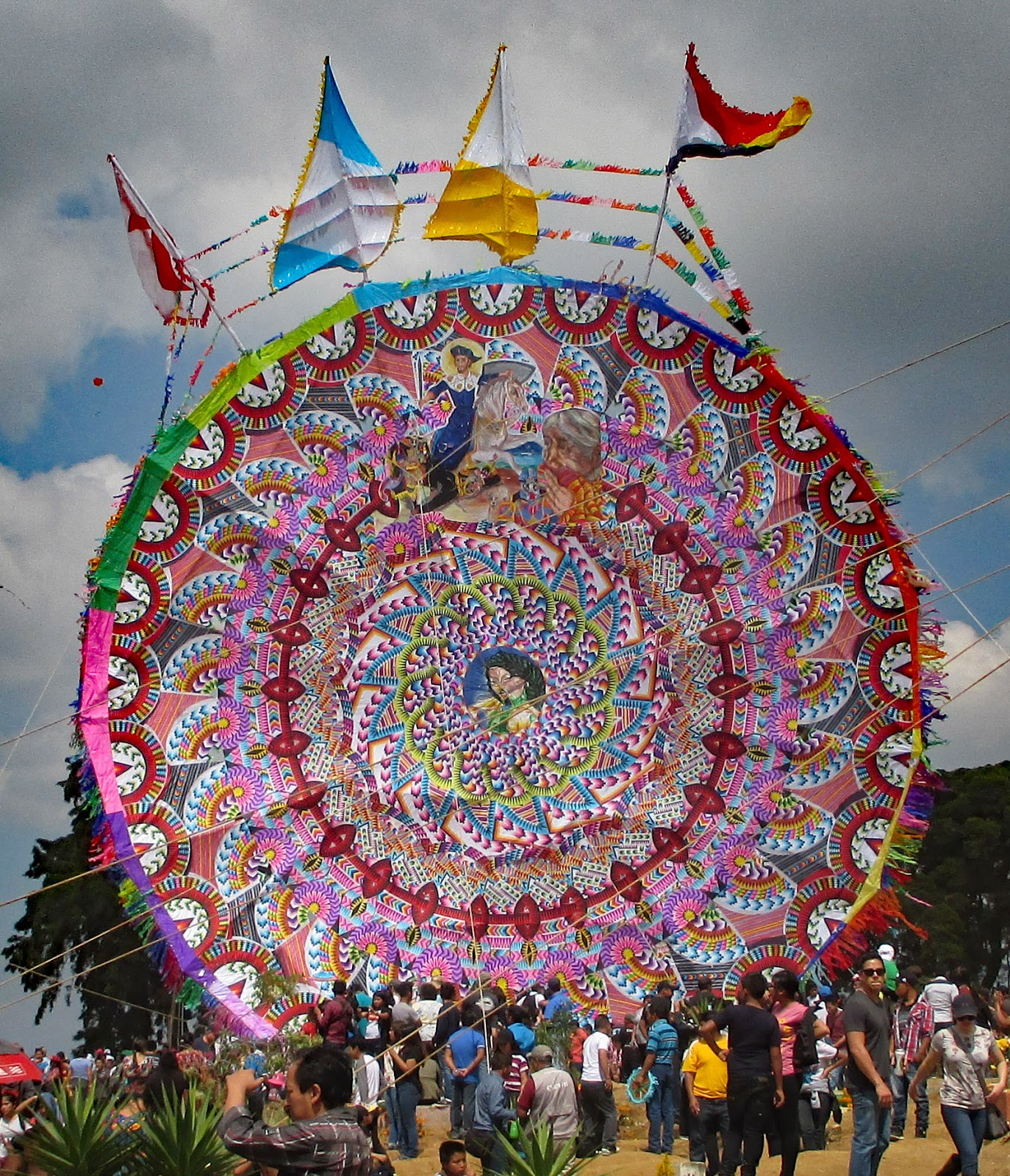 |
| One of the more colorful and intricate designs |
 |
| Close up of the above kite |
 |
| This kite memorializes those that were lost in the quest to travel to the US and a different life |
We have heard mixed stories about the meaning of the kites
but we understand that among various sects, the kites are flown to communicate with
“the beyond”. Among the variations is that the flying of kites grew out of the
belief that spirits come on All Saints Day to bother the residents. What
started as simply taking large pieces of paper to fly in the wind and make
noise to scare away the spirits, became the tradition of flying kites as an
efficient means of dispersing spirits. Today, these vibrant colored and
variously themed kites are flown to honor the dead.
 |
| Kites in all directions flown from a cemetery |
 |
| Everyone gets involved with the wind, even with whirlygigs |
 |
| Teams compete in flying mid-size kites |
 |
| Mid-size kites (about 20 feet across) in competition - higher and longer wins |
Of incense, pomp and
circumstance
Returning to Antigua following the kite festival, we observed
people gathering in front of the cathedral of Saint James on the main square.
Soon a procession of marchers in single file dressed in brown and purple robes
appeared, and the sky filled with dense clouds of fragrant incense. By the time we returned to the hotel, we heard
the haunting melody of the dirge music echo in the narrow streets. Eventually the procession entered the street
in front of our hotel, and continued through the streets of Antigua late into the
evening. The procession was trailed by a giant, over 40-foot-long sarcophagus, decorated
with statues of Jesus, the Virgin Mary, and the Angel Gabriel carried through
the street by over 50 paw bearers keeping in slow march and with a low chant.
The float, festooned with lights powered by a generator pulled behind the procession,
honors the spirits of ancestors- those who suffered and died, and those who
carry great burdens. All of us were quite stunned by the spectacle and none of
us could articulate what we thought of it all. We did agree that travel occasionally
shows us something completely unexpected and extraordinary - And isn’t that one
of the reasons we travel?
 |
| Incense clouds fill the square adjacent to the cathedral |
 |
| Pall bearers (50+) carry this immense sarcophagus through the narrow cobblestone streets of Antigua |
Sharing the Rio With Family - Jena and Brayden
Bud’s niece Jena, and her boyfriend, Brayden, joined us for
a very full week of fun exploring the Rio. Although rainy weather confined us
to the boat for the first couple of days, we made up for it with a couple of
trips and gatherings with cruising friends. We took a fast “lancha” trip 20+
miles down the river through the stunning canyon at the mouth of the Rio. We
caught up with “Polo”, our Garifuna friend from our first arrival in
Livingston, to get a tour of his neighborhood. Polo entertained us with his
views on politics and life in Guatemala. He also explained how his friend Jerry
Garcia (from the Grateful Dead) contributed to the community. Polo then
introduced us to an amazing lunch of “Tapado”, a seafood soup, containing crab,
shrimp and fish.
 |
| Tracy, Jena, and Brayden marvel at their huge bowls of tapado |
 |
| Made with love and time - add coconut, curry, plantains, shrimp, crab, and mangrove snapper |
 |
| We ate it all - mostly |
 |
| Fast lancha back up river from Livingston through the famed cliffs of the lower Rio |
We took another trip to Tenamit Maya, an EcoAdventure Park
on the Rio, which featured an amazing zip line adventure in the jungle,
followed by kayaking down the Tameja River, an old Maya commerce route, and a
late afternoon lunch. As with most
places on the Rio Dulce, Tenamit Maya is most easily accessed by boat. A lancha
picked us up and delivered us to their property down river, with extensive
farmland butting up to a dense canopy at the foothills of the mountain, Cerro
San Gil. It was a thrilling day, with
lots of climbing, zipping, navigating hanging bridges, and paddling. With big smiles and sore muscles, we were whisked
by lancha at sunset back to our marina. It was a perfect way to end the day.
 |
| Tony, Jena, Brayden, Robyn, Tracy, and Bud all geared up for a day of zip lining |
 |
| Jena gets ready for one of the 13 zip lines |
 |
| Bud screaming here like a little girl |
 |
| Bud navigating through the canopy on the obstacle course |
 |
| Tracy makes it look easy high in the canopy |
 |
| The last leg of the journey - kayak trek down the Tameja River to our late lunch |
NEXT TIME: Come back again to read about more of our explorations
in and around Guatemala, including travel to Belize, to spectacular Maya ruins,
cool river trips, caves, and more.


