Thursday, March 31, 2016

One Month in West Palm Beach, FL


Banyan tree on the walk to the grocery store.

Now that you can follow us via satellite we realize there is one problem - Now you want to know, ‘Why are you still in the same place?’  We understand you like to see Layla moving along and there is some adventure in that.  Sitting in one place is not very exciting and you want us to move.

Yes, we are still at anchor off the waterway in between two bridges, Flagler Memorial and Royal Palm bridge, sandwiched in between West Palm Beach and Palm Beach.


West Palm Beach viewed from our anchorage.

Palm Beach (east) viewed from our anchorage.

This protracted visit started when we realized we needed to renew our boat documentation with the Coast Guard.  Layla is a US documented vessel which is renewed annually. This year it was supposed to be pretty simple.  We simply go online and complete the renewal form. 

We need to carry a hard copy of the documentation on the boat which meant, of course that we needed the paper document sent to us.  But, remember we are not at home!  We are on a boat.  Where do you sent it?  We thought about that and now have a mail forwarding service.  Thousands of cruisers do this.  Just use their address.  Simple.  We did that.

The expected time to receive the certificate of documentation is about two weeks - maybe three weeks if there are holidays or snow days. Nothing arrived. The Coast Guard said, “it is not me”.  The mail forwarding company said, “it is not me”.  We went back online and filled out another form and payed a few more dollars to request a certified copy of the lost document.  This time we decided to have it sent to General Delivery at the US Postal Office in West Palm Beach.

Meanwhile, we decided to get a passport renewed.  With only five months remaining on the old passport, many countries want at least 6 months. We didn’t know how long we would stay here and of course, we did not want to sit here waiting in West Palm Beach for the usual expected six weeks for the passport.  We opted to spend a few dollars more to expedite the application with the hope to receive it in 2-3 weeks.   We got new passport photos and went to the post office to complete the form and request overnight shipping both to and from the Department of State.  

Pretty simple?  We completed the form in BLUE ink. We missed seeing the very small type at the top of the form stating that the form must be filled out in BLACK ink.  We had to fill out another form in BLACK ink.  Actually, the postal expert was very helpful, and made all of this less painful.  We sent it with the hope to pick it up at the post office - General Delivery.


Farmers Market in West Palm Beach was a real treat.  It made waiting for documents less painful.  

Excellent bread at the Farmers Market in West Palm Beach.

Since we were having to sit here anyway, we decided to order a few things for Layla - a new gasket kit and a new saltwater pump for the galley because the old pump is leaking badly.  We ordered it to be shipped via the US Post Office.  We learned that we do NOT want to use United Parcel Service (UPS) because the post office will not accept it.  We also learned that you don’t call the post office to see if your package has arrived.  If they do answer the phone, the answer is as expected - the package is not there.

Oh, and how do we get to the post office?  Remember, we are on a boat at anchor.  Simple.  We just take our dinghy to the dock in downtown West Palm Beach and walk about 7 blocks to the post office.  Well, it should be simple, but a boat show was coming to town and it was a BIG boat show with crews with barges and cranes and floating docks (oh my) to accommodate the 1.2 billion dollars of boats.  The police reminded us with a friendly visit to the boat one afternoon, “Do not even think about going ashore between the two bridges or use the dinghy dock for the next three weeks”.


Chaos in the anchorage as yachts arrived for the boat show.

More boats waiting to dock at the boat show.  A little close for comfort. That is Layla's bow.

West Palm Beach waterfront transformed by the boat show.

The marine patrol and police made it very clear that we were not permitted to go ashore anywhere along the mile of shoreline.  We could not simply drop someone ashore.  We were stranded.  We scouted our options outside the city waterfront and found a small beach near a parking lot.  We could drop only one of us there and then come back for a pick up.  Our simple task of going to the post office, or anywhere in town for that matter, was now more complicated.  Only one of us could go, and now we had an extra mile to walk to the post office. 

Our old dinghy started leaking water badly after a couple rough rides to the drop off point.

One benefit of the West Palm Beach boat show - our new tender.

If the wind was blowing, and it did for about 10 days in a row, we got very wet in the bouncy dinghy ride.  Once there, we had to take our shoes off, wade ashore, put our shoes back on, and hike to the post office.  Of course, you know where this is going - When Bud got to the post office (he had to go since it was in his name and you know "there can be no substitutes") there were no packages or mail. Despite tracking numbers and conversations with shippers that said otherwise - they would say with a smirking smile, “You have nothing today-Maybe tomorrow.”

OK.  Is that tedious?  And if that isn’t fun enough, we decided to do our taxes while we were here. (We had considered getting colonoscopies too, but decided against that.)

How did that go?  The new passport was a surprise.  It came back in 10 days, and the old passport was returned a couple of days later. We might be on a roll here. The boat parts came in about nine days, just three days late.  We picked up the copy of the boat documentation 6 days after it was stamped “received” at the post office, nearly one month after we started the process.  And taxes were complete after heroic efforts by 3 different IRS agents who had to look up the information from last years’ fraudulent filing to get the submission accepted.  (Yes we had been victims of identity theft on last year’s return.)

So you see, it was quite simple.  We had little choice in staying in Palm Beach…for a while.

When we could go ashore we found oysters from Maryland on the half shell.

We have learned that patience is essential to life on a boat. Now we will wait for the weather to cross to the Bahamas.


Thursday, February 25, 2016

From Beaufort, SC to Vero Beach, FL


Morning skies overlooking New Smyrna Beach, FL.

In this second report of our southern trek, we report of travel from Beaufort, SC to Florida. When we headed out of Beaufort the weather was still cold, cold, cold.  But we are heading south, to "where the butter melts", and "every decrease in one degree of latitude warms the temperature by five degrees or so".  At least that was our guide.

Now in Florida, we shed the long underwear about a week ago, and wore shorts and short sleeve shirts for the first time here in Vero Beach.  The temperature two days ago was in the mid 80’s.  The scenery with the vegetation and beaches looks tropical. We are moored amidst the mangroves and the water at the beach is clear blue green.


Walking through a live oak canopy (in shorts) on our way to the beach in Vero Beach, FL.

Clear blue green waters at Vero Beach, FL.

The biggest challenge on this stretch of the Intracoastal Waterway (ICW) is the constant shoaling in certain areas.  Sometimes an area will have only 4 feet of water at mean low tide.  Layla is a big girl with 6 ½ feet of draft.  So, we had to be strategic.  We timed our day to travel through the well-known shallow areas at high tide if possible, or at least on a rising tide with at least 7 feet of water predicted in the area.  None of this would have been possible without Active Captain and tide data.  Active Captain is a community-based sailing website, and gives information on hazards to navigation, as well as bridge, marina, and anchorages.  We have the Active Captain database integrated into navigation software on our tablets, which plots the hazards on to the chart, making it very easy to see upcoming hazards while navigating the waterway.  We typically spent about an hour each evening reviewing the upcoming day’s journey.


Doing homework at anchor along the ICW using Active Captain to plan the next leg of our journey.

Our homework paid off, and we successfully navigated the notorious shallows of Georgia and North Florida without going aground.  Among these we transited “Hells Gate” (chart makers love to scare the living daylights out of mariners) with no less than 11 feet under Layla (we anchored about 2 miles from Hells Gate for about 5 hours to get our timing right), Amelia River just south of Fernandina Beach with about 6 inches under our keel, and Matanzas Inlet on a rising tide we touched bottom a couple of times.  There was much drama at this inlet before and after we made it through.  We were contacted by three vessels before entering the inlet, warning us of shoaling in the inlet.  We saw four boats aground as we snaked our way around the buoys and heard of several more boats that later went aground, including an Army Corps of Engineers survey boat!  All of the boats aground had drafts at least 2-3 feet less than ours!  We felt a little smug about that.


Not every cruiser was as fortunate going through Matanzas Inlet.  From left to right, a trawler is aground, SeaTow is pulling off a sailboat, and the Coast Guard is repositioning one of the green nuns.

Our trip down the ICW would not be complete without a boarding request by the Coast Guard for a “free” safety check just north of Brunswick, GA.  There is deep water in this stretch of the ICW (we saw 60 feet!), and there is no way to say “no” to the Coast Guard.  (The Coast Guard probably has this stretch of the ICW dredged so cruisers cannot use the concern of grounding due to shallow depths to refuse a boarding request!)  This is the exact same area we were boarded by the Coast Guard three years ago heading north.  With the experience from three years ago, the safety inspection went smoothly.  We just need to buy some new flares; the flares from our last trip had just expired.     
We waited out a winter storm in early February at Brunswick Landing Marina up the East River about a block from downtown Brunswick, GA.  There were wind gusts over 40 mph, and sustained winds over 30 mph for two days.  We were glad we were protected in a marina about 10 miles upstream from the inlet.  This marina has a lot of nice benefits.  Number one, it provides free beer all day long, every day.  No joke.  Number two, they have a happy hour for the cruisers, providing beer and wine, while the cruisers provide snacks three times a week.  They have loaner bikes available for free to get around town.  And the washers and dryers are free….no quarters needed.  We did a lot of laundry while we were there, and drank a fair amount of beer.


Flags flying stiff in Brunswick, GA during one of the many winter storms we came across on our trip down the ICW.
We participated in one of the happy hours while we were there, and met up with a cruising couple we met in the Vero Beach City Marina three years ago, James and Donna Ostby.  Back then, we were in the galley making some coffee cake, when we heard a knock on the hull.  Tracy popped up into the cockpit, and a man in the dinghy said that he knew one of the previous owners of Layla.  We invited him on board, and listened to some fantastic stories over coffee and cake.  The stories continued at Brunswick Landing at happy hour, and then again for an afternoon and evening aboard their 38 foot Catalina. 

We stopped at several towns for a couple days each.  We visited our cruising buddy, Stein, in Fernandina Beach, FL.  He and Virginia took us to the local farmers market and to a beautiful state park, Fort Clinch.  In St. Augustine, FL, we shopped at the Sailors Exchange, a marine surplus store.  We scored a tether to attach to a jack line (safety line for staying on deck).  Each of these towns has a really nice downtown area with quaint little shops and excellent restaurants.  Layla is too full for any more of the “knick knacks”, and so we avoided those, but we ate well.


Bud and Stein at Fort Clinch State Park in Fernandina Beach, FL.  Notice the pants, coats, and hats.  It was in the 50's in Florida in February.

The weekly Farmers Market in Fernandina Beach, FL.

Eating well at the 4th Street Deli and Salads in Fernandina Beach, FL.

Vero Beach is an interesting town.  For cruisers, it is the northern-most jumping off point to the Bahamas.  Almost all cruisers going up or down the ditch stop here to re-provision, and because of many amenities, it has become also known as “Velcro Beach” (i.e. once you are here it becomes hard to leave-you are stuck).  One of the reasons for the popularity is the town has a free bus system.  The bus picks you up at the marina every hour, and takes you to the grocery store, liquor store, library, West Marine, WalMart,  hardware stores, and the mall…..all for free.  All this convenience makes provisioning easy.  The marina has a nice cruisers lounge with decent WiFi, a good selection of books for swapping, two TV’s (one permanently tuned to the Weather Channel), and a jigsaw puzzle table.  With a nice bank of washers and dryers next door, and the bus stop across the road, there is always a group of cruisers in the lounge, and always interesting conversations.  The only challenge with such a great marina is finding a place at the dinghy dock, and then finding your dinghy when you want to head back to the boat.


Where is my dinghy???

This time of year, normally most cruisers are starting to head north again.  The marina here at Vero Beach is full right now, with nearly all of the 57 mooring balls occupied, and about ten mooring balls with two boats rafted together on one ball.  Evidently, this was nothing compared to this past December, where we heard that all of Vero Beach’s 57 mooring balls had three boats tied together while waiting for a weather window to cross over to the Bahamas!  This was an unusual winter for cruisers, as the weather window closed before it even opened.  Many cruisers never crossed to the Bahamas.  Some stayed in Vero Beach, and some headed for the Keys.  We heard that the major marina in the Keys, Marathon, FL, which has about 400 balls in their mooring field, had a waiting list of over 50 boats wanting a spot in Boot Key Harbor.  We expect Vero Beach’s City Marina to be really full this spring.

We need to get going…. 


Brown pelican looking for a treat in Fernandina Beach, FL.

Breakfast for the opportunist in New Smyrna Beach City Marina, FL.

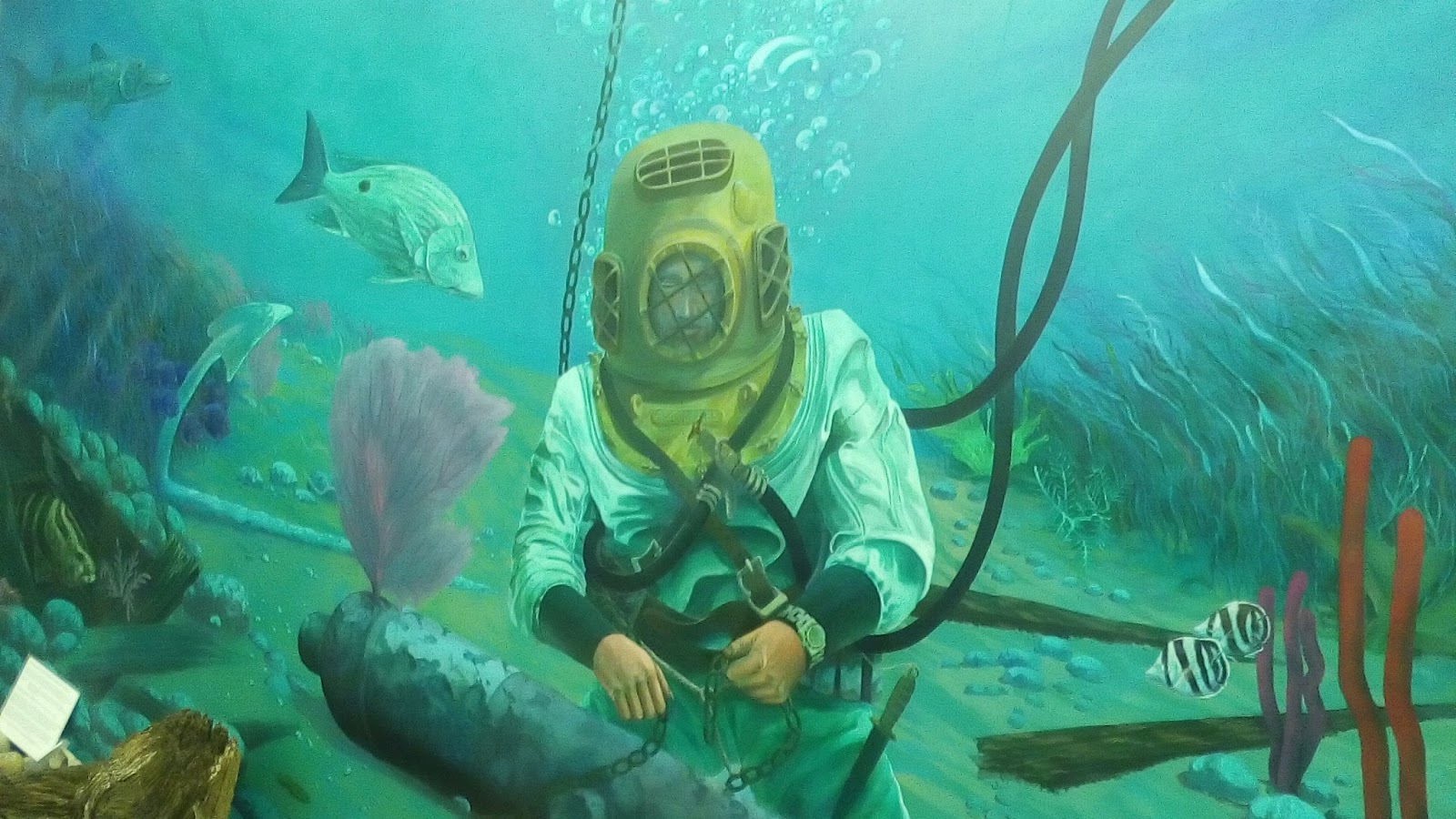
As we do our "homework" at the Vero Beach library a mural of a Marine Archeologist soothes
 the stresses of doing taxes and otherwise catching up to responsibilities of the "land-based life".

If you would like to follow our progress, click on the link below:

https://share.delorme.com/RichardWinn


Thursday, February 4, 2016

From Beaufort, NC to Beaufort, SC


Bundled up for the day down the waterway.

We report on the first leg of our journey from Beaufort, NC (pronounced BO-fort) to Beaufort, SC (pronounced BU-fort).  We left our anchorage in Morehead City, NC on 20 January, with high temperatures in the 40’s.  Sunny, but cold, cold, cold.  We made it to Mile Hammock Bay near Jacksonville, NC just in time to wait out the winter storm Jonas, trying to keep warm with long underwear, several layers, hats, blankets, the propane heater and oven, and hot water bottles.  Did we tell you our journey started off COLD???

Hanging out in the cockpit with long underwear, jeans, sweatpants, turtleneck, sweatshirt, two coats, two blankets, and a hat.

Popping up after turning on the oven to warm up the cabin.

Some mornings you just want to stay in bed.  Cold days on the waterway, especially.  Some mornings you are rewarded for your efforts to get up.  The sun rises and sets everyday – we tend to forget that. Living “outside” helps remind you.


Sunset at our first anchorage of the journey in Swansboro, NC.

Sunset at anchor in Mile Hammock Bay, NC.

Sunset on a mooring in Carolina Beach, NC.

We are adjusting to our life back on the boat.  Some of it is easy and fun.  Some of it, well, tries our patience.  We need to work on that.

One easy and fun thing is laying in the berth listening to the quiet of the water lapping the hull and the gentle rock of the boat in a calm evening.  Among the things that always challenges the patience are the things that break, and break again, and demand that you fix them now.

We made it to Charleston, SC on 30 January, just in time to enjoy a warm spell with temperatures reaching into the 70’s.  Last time we headed south to Charleston, we were welcomed with a warm spell in the 80’s.  Charleston has been good to us.  Today we are moored in Beaufort, SC with temperatures in the 50’s, waiting for a rain front to pass through.  Winter in the Southeast, just like Forest Gump’s box of chocolates, you never know what you are going to get.


Sunset anchored in Charleston Harbor, SC.

Sunrise at anchor in Charleston Harbor, SC.

Much has been said and written about going down the “ditch” traveling the Intracoastal Waterway.  Some say the first time is not to be missed.  The second is tedious and the third time is horrid and something to be missed.  On any one day we may have all of those sentiments.  It can be complicated on the waterway. 

Yesterday was one of those days.  The day started as we delayed our departure to time our passing through difficult cuts (man-made passages through the marshes) with a rising tide.  Nevertheless, in some areas we had no more than six inches of water to spare under our keel!  Following the shoaling challenges, we entered the broad exposed water of St Helena Sound with the full force of 30 – 40 mph winds.  After the rough sound crossing, we snaked towards Lady’s Island Bridge in Beaufort, SC to request the last bridge opening before car traffic rush hour would close the bridge for two hours.  The last challenge was to discover that things had changed in the anchorage since we were here last.  The area was now a mooring area with a very tight field, which meant we had to wiggle in beside other boats while maneuvering in gusty winds and contrary currents.  The day ended with a rum drink in the cockpit while watching a sandpiper munch on critters on our mooring line.   

I heard it said that a wise man understands that most of us actually do get everything we want – we just don’t get it all at the same time.  You should be happy with that.  We are.

Remember you can follow us on our MapShare site:

https://share.delorme.com/RichardWinn


Sunday, January 24, 2016

The Polar Plunge


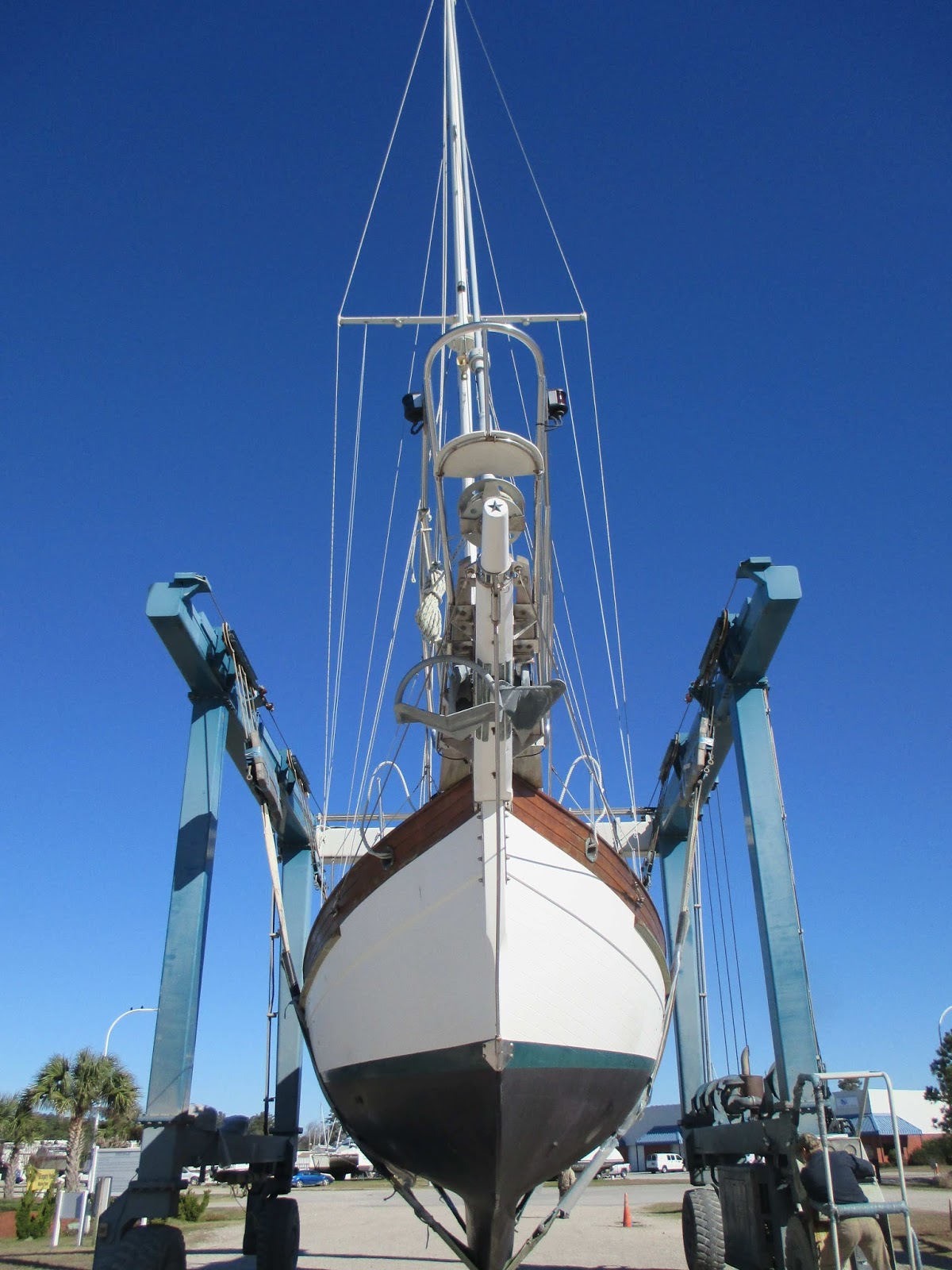
Layla always looks cool from this perspective.

Weather windows be damned.  We weren’t going to wait any longer.  It is only going to get colder.  We have launched (on 14 January, 2016).


Ah...back in the water...


At the Morehead City Docks, just two blocks from our house.

We packed Layla and closed up the house.


The last of the stuff in the house bound for the boat.


A little more chaos and almost there.


We headed south down the waterway.  We are gone.  So the big question, “When are you guys going to leave?” has been finally answered. 

The next big question, “Where are you now?” 


Tune in again for the next dispatch and part of the answer.  Hope you are wearing your hats.  We are.  

Wednesday, January 6, 2016

Happy New Year!


First walk on the beach for the new year


We took our first walk on the beach of the new year here at Fort Macon State Park on Atlantic Beach in North Carolina.  It was a wonderful day with temperature in the 70's.  Of course the weather then changed and it has been below freezing at night and in the 40's during the day for the last several days!

The boat yard was closed for the holidays and then they decided to dredge the launch area. We have not put the boat in the water. As most family and friends know all too well- "cruising is more about intentions than schedules".

We intend on putting Layla in the water next week and move her to a slip for a few days while we make our final arrangements to leave. Yep. The big jump.  We will keep you posted.

Related to the issue of staying in touch, we have discovered a locator device (by InReach) we hope will keep us in touch. We will be able to send short messages (60 characters or less) to email addresses via satellite. Also, those interested will be able to see our location on a map to follow our travel. We will provide some more information shortly. If you think you want to be included in the list of contacts, let us know by sending an email or send a comment here. 

Wish you all the best for 2016.

Remember the words of Mark Twain,

Travel is fatal to prejudice, bigotry, and narrow-mindedness, and many of our people need it sorely on these accounts. Broad, wholesome, charitable views of men and things cannot be acquired by vegetating in one little corner of the earth all one's lifetime.”


Thursday, December 17, 2015

Boat Yard - Still "on the hard"


Tracy and Layla are eager to get back in the water

It is now mid-December and Layla is still languishing in the boat yard ("on the hard"). We have completed a few more boat tasks and tied up an assortment of loose ends before we make the final decision to put Layla in the water and head south. A boat person described life at the end of the year as "Just like a roll of toilet paper. As you get near the end, the faster it goes." Somehow the time has just flown by and we remain here.


Cleaning up the "dynaplate" (necessary for radio "goodness")


We have watched more of our friends from the boat yard make it back into the water and head south.

Stein and Bud making plans


Our favorite Norwegian, Stein, on Anna Rose, just left some days ago. We know we will catch up with him somewhere in Florida, possibly Fernandina Beach.


Anna Rose about to head south


Sunday, November 29, 2015

Happy Tanksgiving!


By Mia on Sailing Vessel Black Cat.

Although we are not cruising, it feels like we are with many of the cruisers we are meeting in the boat yard or at the City Docks.  Among them, we introduced the family and crew on Sailing Vessel Black Cat (Bernard, Karine, Mia, Victor, and crew member Alain) from Montreal, Canada to their first American Thanksgiving.  We enjoyed turkey, dressing, mashed potatoes, gravy, cranberry sauce, green beans amandine, broccoli salad, wine, and Canadian maple syrup pie.  Mmmmmmm.  Hope you had a happy Thanksgiving (or we should say Tanksgiving).


Bernard, Alain, Karine, Mia, and Victor aboard their boat Black Cat.

We just bid farewell to Black Cat and crew Sunday morning on their journey to the British Virgin Islands.  We hope to catch up with them somewhere along the way.


Adding another layer of caulk around the leaky chimney.

What have we been up to lately?  Just finishing up a few house and boat projects before putting Layla back in  the water.  After three weeks of rain, we discovered that our one year old new roof had a leak around the chimney.  This was exceptional rain.  In just one day, we had over eight inches of rain.  Our roofer has made three attempts to fix the leak.  We may know after tomorrow when it is expected to rain again.


Measuring the memory foam topper to fit the new split mattress for the pullman berth.

Another project entailed making it easier to access the storage under our pullman berth.  First we did a test run with our old mattress by cutting it in two pieces width-wise at our knees. It worked great. Now we could easily gain access to storage without both of us holding up the heavy mattress.  By cutting the mattress at our knees, we would not "fall in the crack".  We then bought a 5" queen size mattress foam from Mill Outlet Village fabric shop in New Bern, NC, and used the old mattress as a template to cut the new split mattress.  We then made covers for the two pieces.  To make the bed even more comfortable, we bought a 2 1/2" queen size memory foam topper which we cut to size to fit the split mattress, and also made a cover.  We can't wait to sleep on the boat again.

As you may see, we have modified the format of the blog, just for something different.  We hope you like it. Send us a note.

Wednesday, October 21, 2015

The Art of Travel by Truck and Tent


Campsite at Castle Mountain Campground in Banff National Park, Canada.

Many people have gasped almost speechless, “You mean you camped nearly your entire trip IN A TENT?”

When we weren't visiting friends or family (yellow houses), or recuperating in a motel (red beds), we stayed in over thirty different campgrounds on our trip across country, in a 2 or 4 person tent.

We get that. Travel by truck and tent worked very well for us, but it is not for everyone. We were not on a mission to see how much roughing it we could handle - our aim was to keep things simple. We learned some practical lessons, particularly about adding more stuff.  More stuff demands more attention. More stuff distracts you from enjoying the travel. More stuff has to be packed and more stuff has to be fixed. Remember our beautiful sailboat, Layla, has a lot of stuff and travel on her taught us important lessons. Also, recall last year we traveled to the Canadian Maritime Provinces in our old pickup, and months before that we camped out of the back of our Mini Cooper! Fortunately, we paid attention and learned a few things that guided us on this road trip.

That said we still took a lot of stuff. We packed tents (old tent and new tent), ground tarp, spare large tarp, sleeping bags, pillows, blankets, propane camp stove, pots and pans, utensils, dishes, coffee pot, spices and dry goods, crates, BBQ grill to fit fire rings, ice chest (with some perishables), truck box (to hold gear), air mattresses, water jugs, tools, hatchet, flashlights, clothes and cameras. It was a good idea that we bought a bigger truck.  We used everything we brought. 


Crates, boxes, and coolers helped us pack a lot of stuff efficiently in our truck.
  
Campgrounds.  We traveled at the peak tourist season and did not reserve a single campsite, but we always found a place to sleep. (Yellowstone hit an all-time record of 3.8 million visitors by September this year.) You have a lot more choices for camping than you might think ranging from commercial campgrounds to the federal, state and county parks, forests, and recreational areas. You should also know that nearly all campgrounds set aside some unreserved campsites on a first-come, first-take basis.  

You are probably asking, “With the uncertainty of just showing up and hoping to find a campsite, wouldn’t it be better to get a reservation?”

Reserved sites cost a bit more for the privilege of a reservation (~ $5-$10 more) compared to unreserved sites. A reservation ties you to a schedule and your pre-paid fee is non-refundable. We benefited from this on several occasions when the camp hosts offered us the reserved sites of campers that did not arrive. Sites may be reserved many days, weeks, or even months ahead of time, which may limit the available dates. If you are reserving a campsite online, it can be difficult to evaluate suitability without actually seeing it. You may not have the option of choosing an alternative site if you find your camping neighbors are behaving badly. Reserved sites are not necessarily the best sites in the campground. You may find an unreserved site is comparable or better. However, if you want to stay in one of the most popular campgrounds during the peak times, want a site with amenities and have a tight schedule, it is probably a good idea to make a reservation, although we never did.

Primitive campsites or those with amenities?  In addition to whether to reserve or not to reserve is the decision of the type of campsite you want. There are two types of campsites - primitive and those with amenities (“hookups”). Primitive sites typically have water nearby or at the site, a fire pit, a table, and an area for a tent. Campsites with amenities cater primarily to RV’s. These campsites are often distinguished by their expanded paved or hardened areas for parking larger vehicles or by the driveways to allow the bigger RVs to set up and leave without having to back up. Surrounding trees may be trimmed or removed from RV sites to reduce damage to the big rigs which in turn can transform these areas into exposed parking lots. At a minimum, amenities typically consist of an electrical outlet to plug in standard extension cords and/or 30-50 amp power cords and a water faucet to attach a hose. Campgrounds may have a sewage hook-up on each campsite or access to a disposal area nearby, as well as internet, cable TV, swimming pools, laundry, recreational rooms and more.


Primitive campsite in Dorst Creek campground in Sequoia National Park.  In addition to the tent pad, fire ring, and picnic table, this campsite had a bear-proof food locker to store food and keep hungry bears from ripping into your vehicle.

Campsites with amenities also differ from primitive sites in cost. In our travel across the US and Canada we found primitive campsites ranged from $6 to $26 per night, with an average of about $15 a night. Campsites with amenities cost from $5-$25 more than the primitive sites.


Some campgrounds are self-serve, that is, there is no attendant to collect your money. You simply drive around the campground, find an available site (without a current or reserved receipt attached to the post next to the site), place your fee in a provided envelope and drop it in a lock-box at the campground entrance. Many campgrounds have volunteer camp hosts to oversee the campground, check on paid recent arrivals, and sell firewood (you are not allowed to bring in firewood from outside most parks). We met a diversity of hosts that were friendly, good humored, helpful, and obviously enjoying life.


Welcome station at Belly River campground in Glacier National Park, Montana.  Fee envelopes and pencils for filling out the envelope can be found here, along with a locked deposit box.  Most self-serve campgrounds take cash or check, but some also take credit cards.

Availability of campsites varies significantly among campgrounds, but some unreserved campsites are usually available every day, especially early in the day. We were often successful in getting a campsite if we stopped to select a primitive site between 2:00 to 4:00 pm. Campsites with amenities are in most demand and go quickly.

It is difficult to predict whether you will find the campsite that is just right. Even in the best campgrounds there are the prize campsites such as those with views, privacy, access to water and bathrooms, and those campsites to be avoided if possible. A campsite set back in the trees may seem ideal for solitude but it may also be dark, dank, and mosquito-ridden. Your choice of a campsite may ultimately be determined by when you arrive. Sometimes you just have to settle for whatever you find.

Primitive campers.  Upon first hearing a park agent answer our inquiry about the availability of a tent site by saying “Oh, you want a primitive site,” we imagined all sorts of horrors because primitive sounds, well, primitive. We immediately thought primitive sites might actually be set aside for Neanderthals or another ancestral species similar to Homo sapiens. We imagined primitives sitting around campfires fashioning stone tools and gnawing on bones. We thought we heard the friendly park person say, “Hey, we’ve got another couple of primitives. Should we put them up there on the hill away from the others? You know the trouble those primitives cause when they get too close to the other visitors.”

We are not sure why, because we certainly covered a lot of territory and stayed in a lot of parks, but we did not see a single Neanderthal or any other primitive in any of the campgrounds. We were disappointed. We were looking forward to sitting around the campfire with a primitive sharing our primitive campsite, exchanging jokes about humans, trading secrets about building fires and fashioning new tools, and probably arguing about the latest theories of early human evolution.


We were looking forward to sharing fire building techniques with some of the primitives in the campgrounds, but never got the chance.

Commercial campgrounds vary from excellent to poor, cater mostly to RV’s, often look more like parking lots, and usually cost more than other campgrounds. Most commercial campgrounds have all the amenities including electricity, pools, showers, laundry, internet, and in some places, cable TV. Many commercial campgrounds are located outside the park entrances to accommodate visitor overflow. When we discovered the campgrounds were full in Yellowstone, we found an exceptional alternative in Valley View Campground outside the town of Western Yellowstone with hot showers, laundromat (with free popcorn), internet, friendly and efficient staff, and a tent site in an open field all for $10/night!  We were so pleased that we stayed a couple of days and used this as our base camp to explore the park. Similarly, when we discovered no available campsites in Zion National Park, we found one outside the park in a commercial campground. Our tent campsite was merely a flat area tucked in the bushes beside a bumpy dirt road, the showers/bathrooms were atrocious, and record rainfall made the entire area a muddy mess. To add to the misery, we paid among the highest rates of the entire trip for the site ($30). The next day we learned of the tragedy of the 20 people killed by floods in Zion and in a nearby local community. We recognized that, despite the campground’s shortcomings, we were fortunate we found a place to pitch our tent and remained safe and dry.  


Campsite in Valley View campground might not have had the solitude we sought, but gave us a base camp for exploring Yellowstone National Park… 

...and great skies at sunset.

One of the least aesthetic and most expensive campgrounds of all our camps was at Zion Mountain Ranch on the east side of Zion National Park, Utah. Although most of the campground roads were flooded and muddy from rain all night long, we stayed dry in our tent.
  
National parks are popular and rightly so - they are the crown jewels. However, we were surprised to hear that only a small fraction of the millions of visitors actually stay in the national parks and most stay for a VERY short time. A ranger told us that the average stay of a visitor in Glacier National Park is 2 ½ hours! He explained it may take more time than that to drive through the entire park without stopping! The crowds in the campgrounds actually represent that small fraction of visitors who choose to enjoy the park up close and at a slower pace.

National park campgrounds are predictable and consistent with what they provide. Without exception we found the park personnel were helpful, talkative, cheerful, and apparently, as they said it often, quite pleased to see us. All national parks have an entrance fee of $20-$30 (unless you have purchased a lifetime senior pass, 62 and over) which gives you access for seven days (bad timing as I was not yet eligible). With a few exceptions, you must pay the entrance fee at each park. Also, the fee does NOT include the camping fee.

The iconic parks such as Yellowstone, Yosemite, Sequoia, and Glacier are very popular, fill early and can be very crowded. Campgrounds (many with flush toilets and showers) are usually well-managed and fairly clean. Depending upon the park, there may be several campgrounds within the park comprised of numerous but fairly small campsites placed close together. You can expect a lot of neighbors. (Have you ever observed how well sounds, especially voices, travel in the forest?) There are often a fair number of unreserved sites, but there is heavy demand, particularly for full-hookup sites. Primitive sites are usually more readily available.


A highly prized primitive campsite at Apgar campground in Glacier National Park, Montana (read below).  We had neighbors to our right, neighbors to our left, neighbors in front of us, and cars zooming by just beyond the trees.  Despite the close quarters and road noise, the campers kept their voices to a minimum.

You may find a list of the campgrounds and their status as full or open at the entrances to the park, although these signs may not be accurate especially if the campground is many miles from the entrance (which many are). Don’t count on availability of a campsite even after the helpful Ranger called to confirm with the campground host. In a park that sees over 3 million visitors a year, availability can change very quickly. Many prospective campers troll through the campground early in the morning to grab unreserved campsites as soon as they are vacated. In Glacier National Park campers arrived at our site at 8 am and waited while we packed to leave. These campers completed the registration for our site before we loaded the last of our gear in the truck.


Camping options at Yellowstone National Park were limited, even when we arrived around noon.  By the time we had driven to Indian Creek and Lewis Lake (shown as open), both campgrounds were full.

National parks are certainly not the only camping areas with this problem; the parks’ popularity inevitably means the crowds can be annoying. Considering the immensity of the national parks and that most visitors are concentrated in the most easily accessible areas, we learned from a ranger that 90% of the parks are unseen by 99% of the people! If you seek real solitude and want to experience more than drive-by vistas, consider obtaining a wilderness permit and hiking into one of these less traveled areas. Although this may be roughing it more than you might want, we were continually inspired by people we met on trails with wilderness-induced smiles that affirmed they were having the times of their lives and that the effort was worth it.

Primitive campsite at Tamarack Flat in Yosemite was down a three mile narrow newly paved road. We found uncommon solitude in a national park campground.  Potable water was available from the creek after boiling, bathrooms consisted of vault latrines, and of course there were no showers.  Living without the amenities for a couple of days was a worthwhile trade for the natural beauty and solitude.
    
In the peak travel months you may not find a vacant campsite in the national park, but don’t fret, you usually have other options nearby such as in the commercial campgrounds and national forests.

National forests are managed forests where logging, hunting, grazing, and other activities are not heavily restricted as in the preserved areas of national parks.  Some national forests have lower fees (usually self-serve), some have campgrounds with well-organized campsites whereas others have campsites with minimal or no amenities, or no designated campsites at all. In some forests you are allowed to camp wherever you find a suitable spot. National forest campgrounds are often adjacent to national parks which also make them a good alternative to the popular and crowded parks. We stayed in a number of national forests and generally liked them very much. We found a good campsite in the Coconino National Forest outside of Flagstaff, Arizona. The campsites were a little ragged and very basic consisting of simply a level area for the tent and a fire pit surrounded by boulders off a dirt logging road. It was just what we needed. 


Campsite in the Coconino National Forest, Arizona off of Forest Road 535.  All the campgrounds in the very popular Oak Creek Canyon were full, but were told that we could camp anywhere in the forest.  Our site had no tent pad, no picnic table, no water, and no bathroom, but plenty of space.  

National Forest campgrounds provided great solitude.  Our campsite (one of about twelve in the campground) in the Bighorn National Forest in north-central Wyoming overlooked Leigh Creek.  We fell asleep to the sound of the bubbling creek.

State Parks/Forests are a mixed bag; some are among the best, whereas others are to be avoided. State parks typically have amenities such as flush toilets and showers. The majority of visitors appear to be locals. If you are not a resident of the state, you must pay a visitor fee in addition to the camping fee. Our two favorite State Park campgrounds were Center Lake Campground in South Dakota's Custer State Park and Hidden Springs Campground in California's Humboldt Redwoods State Park.  Center Lake Campground gave us good access to Mount Rushmore, Crazy Horse Monument and the Black Hills of South Dakota. Showers and water were available, and campsites were well proportioned. The campground was made more memorable by the friendly and interesting fellow campers we met, including the French family touring the US, a family moving newlyweds to start new lives in graduate school in Virginia, and the generous neighbor who brought a pot of coffee and lively conversation to start our day.  Hidden Springs Campground wound up and through a redwood forest, with each site carefully cut out amidst the large trees, providing unexpected privacy and natural beauty.

      
Campsite in the Humboldt Redwoods California State Park along the Avenue of the Giants scenic highway.

How often to you get to sleep amidst a redwood forest?

Recreational areas, whether federal, state or other, deserve a visit. They are typically found near a lake, reservoir, dune or other attraction, and as their name indicates, these have an emphasis on recreation. Locals flock to these areas, particularly on long weekends. Be aware that you may be sharing a very busy campground with scores of your newest best friends on all-terrain vehicles, dune buggies, motorcycles, jet skis and boats. Oregon Dunes Recreation Area is such an example. Another example of recreational area we visited is the Oahe Dam Recreation area located on the Missouri River outside Pierre, South Dakota (Bud’s birthplace). As both Bud’s father and grandfather had worked on this dam in the 1950’s, camping at the base of the dam and taking a swim (very short) in the very cold downstream waters added to the feeling of a pilgrimage. (In the first seconds of dipping into the water we understood the water flowing by the camp originated at the base of the deep reservoir). The downstream campground was well-organized with perhaps a 100 campsites nearly all occupied. It was a popular for good reason as it was pleasant choice to spend a warm summer weekend in South Dakota.


Campsite at the Oahe Dam Recreation Area was just a couple hundred yards from a swimming beach on the Missouri River, just beyond the cottonwood trees.

We fell asleep listening to the wind rustling the leaves of the cottonwood tree.

Traveling in Canada deserves a special note. Beyond the joys of traveling in a country that seems at first just like the states, but one that then surprises you with the charming, odd and interesting differences, a visit to Canada will do for you what travel should do - change your perspectives and increase your desire to explore further. The Canadians were friendly and welcoming, and the provincial and national parks we visited offered stunning and incomparable vistas, amazing critters, challenging trails, and dazzling discoveries every day.


Travel with truck and tent gave us the flexibility to take advantage of a diversity of campsites throughout the country and immersed us in the outdoors on the level we sought.  Quite simply, it met our needs.  You don’t have to travel by truck and tent.  Find what works for you, and go.  Just go and go soon.